
Key facts
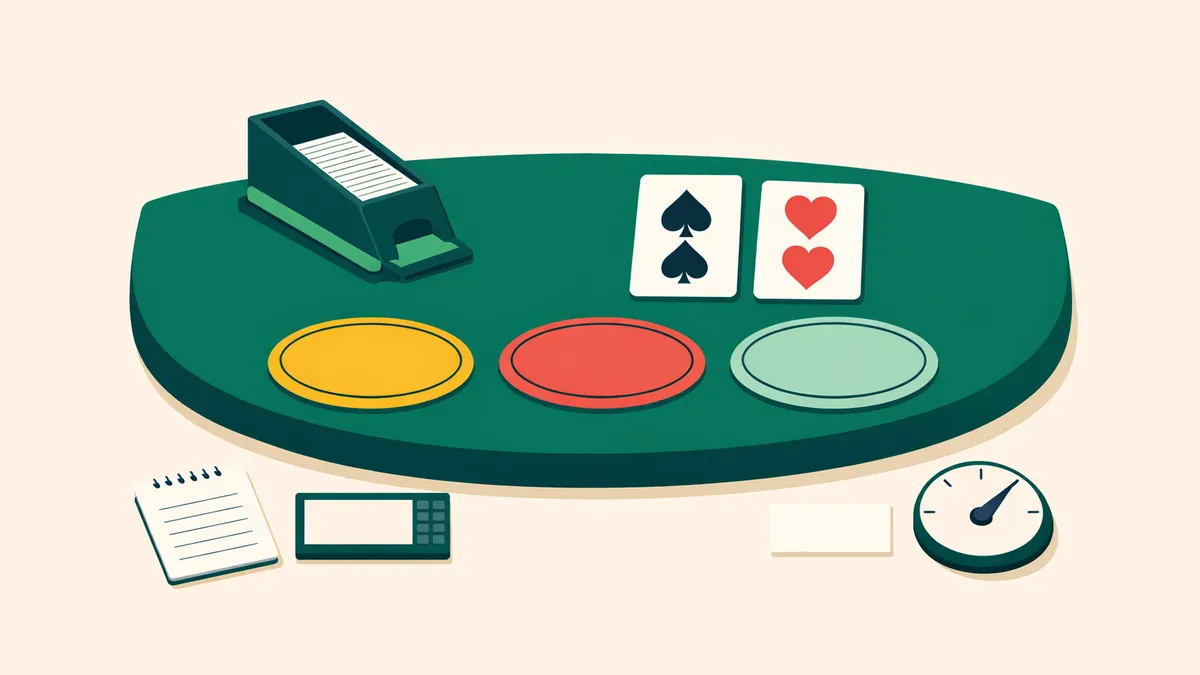
- You bet on the banker hand, the player hand or a tie. The hand closest to 9 wins; the cards are dealt by fixed rules, so you make no decisions after betting.
- In our exact calculation for 8 decks, the banker wins 45.86% of hands, the player 44.62% and a tie 9.52%.
- House edge: banker 1.06% (after the 5% commission), player 1.24%, tie at 8 to 1 a hefty 14.36%.
- If a casino pays 9 to 1 on the tie, its edge falls to 4.84%, still several times worse than banker or player.
- Baccarat is legal in person at Australian casinos. Online baccarat is a casino game that cannot legally be offered to people in Australia.
How to play baccarat in five steps
Baccarat is a card game where you bet on which of two hands, the banker or the player, will finish closer to 9. Despite the names, you are not the player and the casino is not the banker: they are just the labels on the two hands.
- Bet on banker, player or tie before the deal.
- Two cards each are dealt to the player hand and the banker hand.
- Score each hand. If either has 8 or 9 (a "natural"), both stand and the hand is over.
- Third cards are drawn, or not, by the fixed rules below. Nobody chooses.
- Settle. The higher total wins. Equal totals are a tie, and banker and player bets are returned.
Card values and scoring
| Cards | Value |
|---|---|
| Ace | 1 |
| 2 to 9 | Face value |
| 10, Jack, Queen, King | 0 |
Add the cards and keep only the last digit. A 7 and an 8 make 15, which counts as 5. A 9 and a King make 9. You can never go bust; the highest possible total is 9.
The third card rules
This is the part that looks complicated. You do not need to memorise it, because the dealer applies it, but it explains why the banker bet wins more often.
The player hand (it always acts first):
| Player's first two cards total | Player |
|---|---|
| 0 to 5 | Draws a third card |
| 6 or 7 | Stands |
| 8 or 9 | Natural: both hands stand |
The banker hand: if the player stood, the banker draws on 0 to 5 and stands on 6 or 7. If the player drew a third card, the banker follows this table:
| Banker total | Banker draws if the player's third card is | Banker stands if it is |
|---|---|---|
| 0, 1, 2 | Anything | Never |
| 3 | Anything except 8 | 8 |
| 4 | 2 to 7 | 0, 1, 8, 9 |
| 5 | 4 to 7 | 0 to 3, 8, 9 |
| 6 | 6 or 7 | Anything else |
| 7 | Never | Always |
The banker gets to see the player's third card before deciding. That small information advantage is where the banker's extra wins come from.
Baccarat payouts and house edge
We calculated every possible deal from an 8 deck shoe, removing each card as it is dealt, using the drawing rules above.
| Result | Chance per hand |
|---|---|
| Banker wins | 45.86% |
| Player wins | 44.62% |
| Tie | 9.52% |
| Bet | Pays | House edge |
|---|---|---|
| Banker | 1 to 1 less 5% commission (0.95 to 1) | 1.06% |
| Player | 1 to 1 | 1.24% |
| Tie | 8 to 1 | 14.36% |
| Tie (where paid at 9 to 1) | 9 to 1 | 4.84% |
Ties are where the edge on banker and player looks smaller than it is: a tie returns those bets, so you play many hands without a result. Measured only on hands that actually decide a banker bet, its edge is 1.17%.
No-commission tables. Some tables drop the 5% commission and make up for it another way. One version pays only half on a banker win with a total of 6, which happens on about 5.39% of hands. In our calculation that version's banker bet has a 1.46% edge, worse than paying commission. Our baccarat strategy guide compares the no-commission formats and prices every side bet.
What baccarat costs per session
At $25 a hand and 60 hands, you bet $1,500. On average that costs:
| Bet every hand on | Average cost of 60 hands at $25 |
|---|---|
| Banker | $15.87 |
| Player | $18.53 |
| Tie at 8 to 1 | $215.39 |
Banker and player are among the cheapest bets in the casino. The tie is one of the most expensive bets on any table. For comparison, the same $1,500 on single zero roulette costs $40.54 on average; our roulette odds guide has the full table.
Pundit tip: bet banker or player and never tie. Switching between banker and player because of a "streak" on the scorecard does not help: banker stays the slightly cheaper bet on every hand.
Patterns, scorecards and streaks
Baccarat tables often show scorecards of past results, and players look for streaks. The shoe is shuffled and the drawing rules are fixed, so past hands tell you very little about the next one, and a run of banker wins does not make a player win due. Expecting one is the gamblers fallacy. Treat the scorecard as decoration.
Baccarat casino rules in Australia
Baccarat is played in person at licensed Australian casinos, and new versions need the regulator's approval. In Victoria, the VGCCC's published decisions include allowing a continuous shuffling machine without a cutting card (December 2024), adding Dragon Tiger side wagers and removing the Tiger and Tiger Pair side wagers (October 2025), and introducing Immortal Baccarat with an optional Immortal Dragon side wager (August 2026). Side wagers have their own pay tables and edges, separate from the numbers above. Dragon Tiger is also a separate game with one card each; our dragon tiger guide covers its rules and why the tie rule decides the price.
Online baccarat, including live dealer casinos and live baccarat tables that stream a real dealer, is a casino-style game that cannot legally be offered to people in Australia under the Interactive Gambling Act. If you want a card game where your decisions change the odds, read our blackjack rules guide, and see the casino games guide for how every game compares.
Our partner sites
Terms checked 8 to 9 October 2026We earn a commission if you join through these links; it pays for the site and does not change the facts we show. Listed in no particular order. Every detail comes from the casino's own terms, except ACMA notes, which come from ACMA's blocked list. These are offshore casinos without an Australian licence, so BetStop and Australian dispute services do not cover them: read whether online pokies are legal in Australia and our affiliate disclosure.Commission links. Offshore sites with no Australian licence or BetStop cover: is it legal?

LuckyOnes
Partner · termsTerms checked 9 Oct 2026- Withdrawals
- AUD 6,000 a day
- Max bet (bonus)
- AUD 8
- Min deposit
- AUD 30
- Names no licence or operating company in its terms or footer
- luckyones.com, luckyones1.com and luckyones7.com are on ACMA's blocked list (8 Oct 2026)Main domain on ACMA's blocked list

Wild Tokyo
Partner · termsTerms checked 8 Oct 2026- Withdrawals (entry)
- AUD 800 a day
- Max bet (bonus)
- AUD 8
- Monthly cap (entry)
- AUD 13,000
- States a Curacao eGaming licence (no number shown)
18+ Offers and terms change often; the casino's own terms always apply. Never gamble money you need. Free help: Gambling Help 1800 858 858, 24/7.
Frequently asked questions
How do you play baccarat?
Choose to bet on the banker, the player or a tie, then two hands of two cards are dealt. Each hand is scored by adding the cards and keeping the last digit, so 7 and 8 make 5. A third card may be drawn under fixed rules, and the hand closer to 9 wins.
Which baccarat bet has the best odds?
The banker bet. In our calculation for the standard 8 deck game it has a 1.06% house edge after the 5% commission, against 1.24% for the player bet. The tie bet at 8 to 1 has a 14.36% edge.
Why is there a commission on banker bets?
Because the banker hand wins more often, 45.86% of hands against 44.62% for the player in our calculation, mainly because it acts after the player's third card. Without a commission the banker bet would favour the player, so casinos keep 5% of banker wins.
Should you bet on a tie in baccarat?
Not if you care about value. A tie happens about 9.5% of the time, so at 8 to 1 the bet loses about 14.4% of what you stake on average. Even at 9 to 1 the edge is 4.84%, roughly four to five times the banker bet.
Do patterns or scorecards help in baccarat?
No. The cards are shuffled, the drawing rules are fixed and each hand is effectively independent of the last. Scorecards record what happened; they cannot tell you what comes next.
Related reading
 Casino games Casino war Casino war is the childhood card game with a house edge bolted on. There is one decision in the whole game, and getting it right cuts your cost by more than a third. Read more
  Casino games Caribbean stud Caribbean stud poker pays up to 250 to 1 on a royal flush in Queensland, yet that barely moves the maths. We solved every hand against every dealer upcard: here is the cost and the raises that matter. Read more
  Casino games Baccarat strategy Baccarat strategy is short: bet banker, skip the tie and most side bets, and control how many hands you play. Here is the house edge on every bet we could find in an Australian rule book, worked out exactly. Read more
  Casino games Blackjack strategy How to play blackjack, what it pays and the complete basic strategy chart for the most common shoe game, computed with our own solver. Plus what each mistake costs and which table rules quietly raise the house edge. Read more
  Casino games Craps Craps looks like chaos, but the core game is two rolls of logic: a come-out roll, then a point. Learn the line bets first, add odds, and leave the centre of the table alone. Read more
  Casino games Money wheel The money wheel is the simplest bet in the casino: pick a symbol, watch the wheel. The price is printed in the segment count, and one Australian pay table costs twice as much as the others. Read more
 Sources
Official pages we relied on. If anything here has changed, tell us via the contact page and we fix it.