
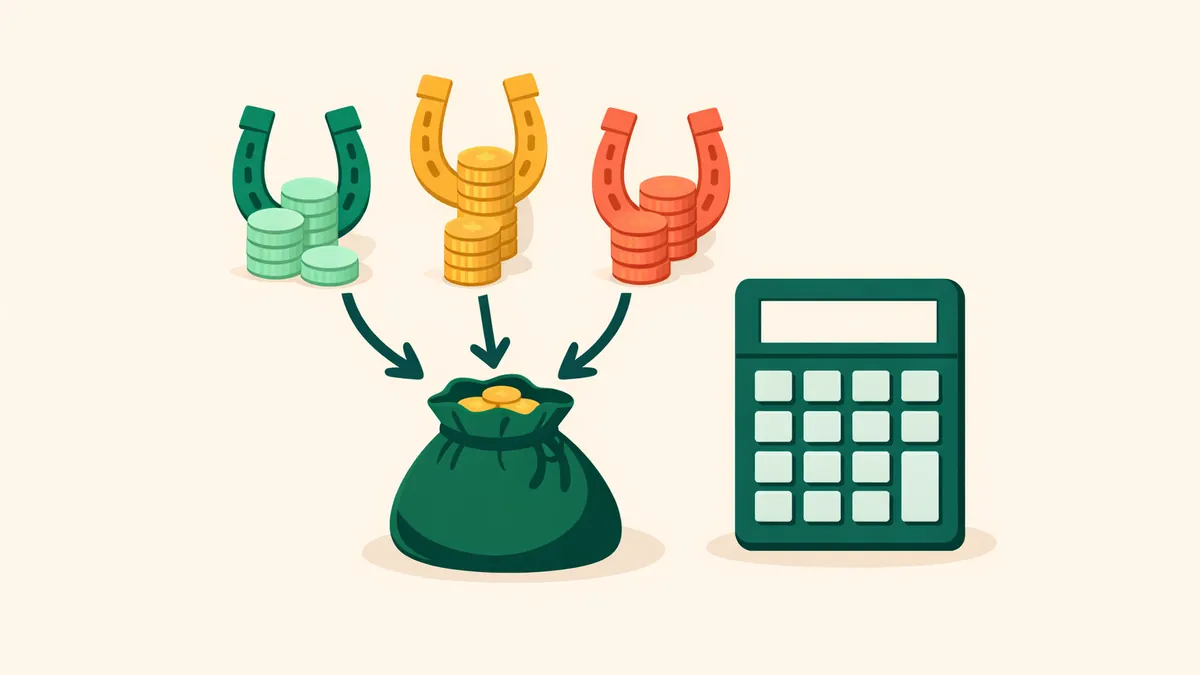
Dutching calculator
Key facts
- Dutching backs several selections so each one returns the same amount if it wins.
- Stake on each pick = total stake x (1 / its odds) / (sum of 1 / odds of all picks).
- $60 across runners at $3.50, $5.00 and $7.00 is $27.27, $19.09 and $13.64, returning about $95.45 if any of them wins.
- A dutch only shows a profit when the implied chances of your picks add up to less than 100%. $1.80 and $2.20 add up to 101.01%, so you lose 50 cents on $50 even when one wins.
How to use the dutching calculator
Enter the total you want to spend, then the decimal odds of each selection you want to back. Add or remove prices with the buttons. The calculator shows how much to put on each selection, what each one returns if it wins, the combined implied chance of your picks, and your profit or loss if one of them gets up.
If none of your selections wins, you lose the whole total. The calculator does not hide that, and neither should you.
What dutching is
Dutching means backing more than one selection in the same race or match, with the stakes sized so every winner pays the same. Punters use it when they have narrowed a race down to a few runners but cannot split them. Instead of three separate bets with three different results, you get one result: you either collect a set amount or lose the lot.
The dutching formula
Each stake is in proportion to the implied chance of its price.
- Work out 1 / odds for each selection.
- Add them up. This is the combined implied chance of your picks.
- Stake on each selection = total stake x (1 / odds) / combined chance.
- Return if any selection wins = total stake / combined chance.
The combined chance also tells you the single price your dutch is worth: 1 / combined chance. Three runners at $3.50, $5.00 and $7.00 combine to 62.86%, which is the same as one bet at $1.59.
Worked example: dutching three horses
You have $60 for a race and like three runners at fixed odds of $3.50, $5.00 and $7.00.
| Runner's price | 1 / odds | Stake | Returns if it wins |
|---|---|---|---|
| $3.50 | 28.57% | $27.27 | $95.44 |
| $5.00 | 20.00% | $19.09 | $95.45 |
| $7.00 | 14.29% | $13.64 | $95.48 |
| Total | 62.86% | $60.00 |
Whichever of the three wins, you collect about $95.45, a profit of about $35.45. The few cents of difference come from rounding stakes to the cent. If any other runner wins, you lose $60.
The calculator opens with three prices of $4.00, $6.50 and $9.00 and a $100 stake. Those combine to 51.50%, so the dutch returns $194.19, the same as a single bet at $1.94.
Rounding stakes to whole dollars
Most punters round. Rounding the example above to $27, $19 and $14 changes the returns slightly.
| Price | Rounded stake | Returns |
|---|---|---|
| $3.50 | $27 | $94.50 |
| $5.00 | $19 | $95.00 |
| $7.00 | $14 | $98.00 |
The outlay is still $60, and the gap between the best and worst result is $3.50. Of every way to split $60 into whole dollars across these three prices, this one keeps that gap smallest; $28, $19 and $13 doubles it to $7.00. Check the returns after you round, not just the total.
When a dutch loses even if you pick the winner
A dutch only makes a profit when your picks' implied chances add up to less than 100%. Back the two favourites in a race at $1.80 and $2.20 and they add up to 101.01%. Spread $50 across them, $27.50 and $22.50, and either winner returns $49.50. You were right and still lost 50 cents.
That is the market margin at work. The more runners you add, the closer your combined chance gets to the whole market total, which is always over 100% at one bookmaker. Check any market with the implied probability calculator.
Pundit tip: each runner you add to a dutch shortens the price of the whole bet. If dropping the weakest pick still leaves you happy, drop it.
Dutching calculator for horse racing: fixed odds only
Dutch with fixed odds. The TAB says a fixed price is locked in when the bet is placed, subject to scratchings and dead heats. Tote dividends keep moving until the race starts, so stakes worked out from approximate dividends rarely finish even. Our guide to tote vs fixed odds explains why.
Scratchings break a dutch. On the TAB, win bets on a scratched runner are refunded, so that stake comes back to you. Tabcorp also publishes a schedule of deductions for fixed odds racing, set by the price of the runner, which is why the returns on your other runners can change after a late scratching. Re-run the calculator after a scratching and top up if you want the dutch even again; the deductions calculator shows what a deduction does to each price.
Dutching, place bets and arbitrage
Dutching three runners to win is a different bet from backing one of them each way. If you want a payout when your one runner finishes second or third, the each way calculator shows that trade-off. If the best prices from different bookmakers cover every outcome and add up to under 100%, that is an arbitrage, and the arbitrage calculator works out the stakes. For the basics of a racing bet slip, read how to bet on horses, or browse every tool on our bet calculators page.
Frequently asked questions
What is dutching in betting?
Dutching means backing more than one selection in the same event with stakes sized so that you collect the same amount whichever of them wins. It turns several bets into one bet at a shorter combined price.
How do you calculate dutching stakes?
Work out 1 / odds for each pick and add them up. Each stake is your total multiplied by that pick's 1 / odds, divided by the sum. Your return is the total stake divided by the sum.
Is dutching profitable?
Not by itself. Dutching only spreads your money; the bookmaker's margin is still in every price. It pays over time only if your picks win more often than their combined implied chance suggests.
Can I dutch tote bets?
Not accurately. Tote dividends keep moving until betting closes, so stakes worked out from approximate dividends will not return equal amounts. Dutching works on fixed odds, where the price is locked in when you bet.
What happens if one of my dutched horses is scratched?
On the TAB, win bets on a scratched runner are refunded, so that part of your dutch comes back. Fixed odds on the other runners are subject to scratchings, so their returns can change, and the dutch will no longer be even.
Related reading
 Calculator Deductions calculator When a runner is scratched after you bet, your fixed odds payout gets cut by a set number of cents in the dollar. Enter the deduction your bookmaker announces and see your real price and return. Read more
  Calculator Expected value calculator Expected value is what a bet wins or loses on average if you could place it thousands of times. Compare the price with the chance you believe in, and see whether the bet is worth anything. Read more
  Calculator Hedge bet calculator Got a futures bet or a multi that is one result from paying? Work out how much to put on the other side to guarantee a profit, what that guarantee costs you, and when a hedge cannot lock anything in. Read more
  Calculator Implied probability calculator Type in every price in a market. See the chance each price implies, how much the market adds up to, the bookmaker's margin and the fair price once that margin is stripped out. Read more
  Calculator Kelly criterion calculator Kelly sizes a bet from two numbers: the price on offer and your own estimate of the chance. See the stake it suggests, and why a wrong estimate makes full Kelly dangerous. Read more
  Calculator Pokies calculator Put in your bet, your speed and the game's RTP. See what an hour of pokies costs on average and how long your budget really lasts. Read more
 Sources
Official pages we relied on. If anything here has changed, tell us via the contact page and we fix it.