
Key facts
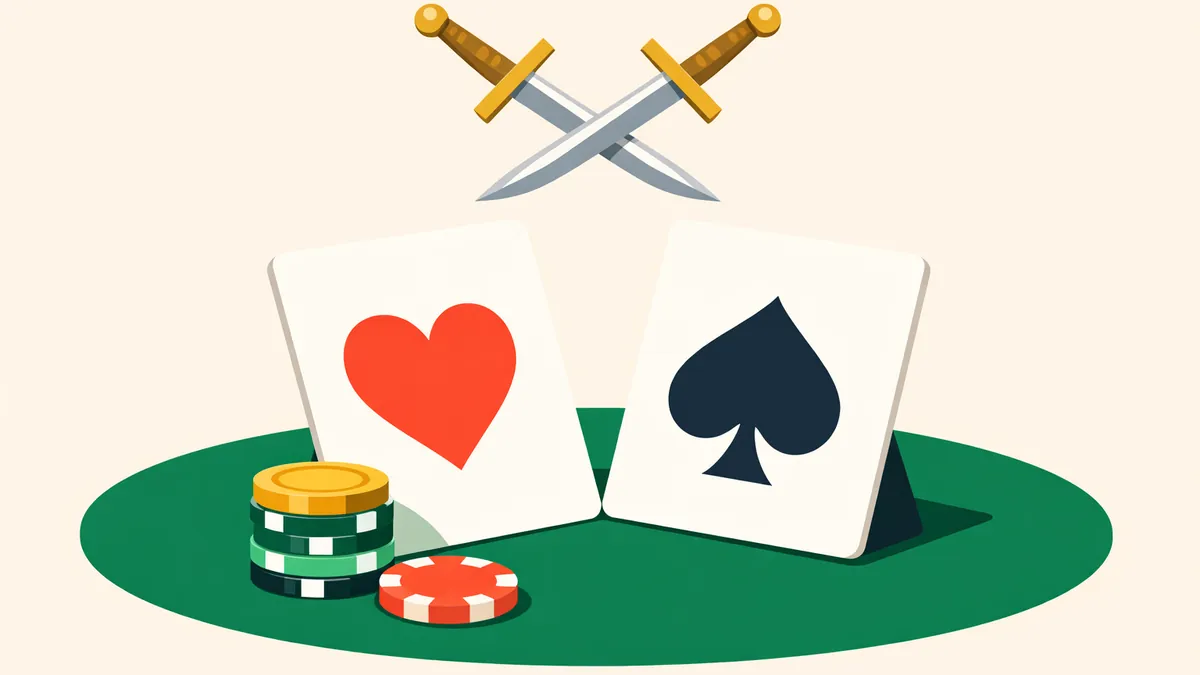
- Each player and the dealer get one card; the higher card wins 1 to 1. Aces are high and suits do not count.
- When the cards tie (7.40% of hands with 6 decks, in our calculation) you either surrender half your bet or go to war by doubling it. Always go to war.
- Going to war gives casino war a house edge of about 2.33% of your first bet under the Queensland and ACT rules, in our calculation. Surrendering every tie raises it to 3.70%.
- The tie side bet pays 10 to 1 and wins only 7.40% of the time with 6 decks: an 18.65% house edge. The electronic version in Queensland pays 11 to 1, still 11.25%.
- Casino war is on the list of approved games for Melbourne's casino and has rules in Queensland and the ACT. Online casino war cannot legally be offered to people in Australia.
Casino war rules, start to finish
Casino war is a one-card game against the dealer. It is about as simple as gambling gets, and the Queensland Casino Gaming Rule (schedule 13) and the ACT's Casino Control (Casino War) Approval 2018 set out almost the same rules.
- Bet. Place a casino war bet in your box. You may also place an optional tie bet.
- Deal. You get one card face up, and so does the dealer. Queensland uses 6 or 8 decks; the ACT rules allow six to eight.
- Compare. Ace is the highest card, then king down to 2. Suits carry no rank.
- Higher wins. Your card higher: you win 1 to 1. Lower: you lose.
- Tie. If the ranks match, you choose: surrender half your bet, or go to war by placing a second bet equal to the first.
- War. Each player who went to war and the dealer get another card. Equal or higher: you win. Lower: you lose both bets.
Settlement order matters little, but the ACT rules settle tie bets first, then casino war bets. Not deciding at a tie counts as surrender under the ACT rules, so say what you want.
How the war is paid
The two rule books word it differently and reach the same result.
| Your war card | Queensland rule | ACT rule | Net result on $10 + $10 |
|---|---|---|---|
| Higher than the dealer's | First bet void, war bet wins 1 to 1 | War bet wins 1 to 1, first bet stands off | +$10 |
| Equal to the dealer's | First bet void, war bet pays 2 to 1 | First bet wins 1 to 1, war bet wins 1 to 1 | +$20 |
| Lower than the dealer's | Both bets lose | Both bets lose | minus $20 |
So winning a war only earns you one bet's worth, while losing it costs two. That lopsided payout is how the house makes its money from ties.
Go to war or surrender?
This is the only decision in casino war, and the maths is clear. With 6 decks, once the tied pair is gone, your war card beats the dealer's 46.30% of the time, loses 46.30% and ties 7.40%, in our calculation. Your expected result from a war, per unit of your original bet:
0.463 x (+1) + 0.074 x (+2) + 0.463 x (minus 2) = minus 0.315
Surrender costs exactly half a unit, minus 0.5. Going to war costs 0.315. War is better every time, by about 18.5 cents per dollar of your first bet on each tie.
| Strategy at a tie | House edge, 6 decks | House edge, 8 decks |
|---|---|---|
| Always go to war | 2.33% | 2.34% |
| Always surrender | 3.70% | 3.73% |
Those edges are measured against your first bet. Because you sometimes put a second bet down, the cost per dollar actually wagered when you always go to war is a little lower, 2.17% with 6 decks.
Pundit tip: casino war gives you one decision. Make it once, before you sit down: always go to war, never take the tie bet.
The tie bet
The tie bet is a side bet that your first card and the dealer's first card share a rank. It is paid at 10 to 1 under both rule books; the electronic casino war in Queensland's schedule 13(a) pays 11 to 1.
| Tie bet | Wins (6 decks) | House edge (our calculation) |
|---|---|---|
| 10 to 1, table game | 7.40% | 18.65% |
| 11 to 1, electronic version | 7.40% | 11.25% |
| 10 to 1, 8 decks | 7.47% | 17.83% |
To break even at 10 to 1 a tie would need to come up one hand in 11, or 9.09% of the time. It comes up about one hand in 13.5. Even the better electronic price leaves the tie bet several times more expensive than the main game.
What a session costs
At $10 a hand, a table dealing 60 hands an hour takes $600 of first bets from you. At 2.33%, that is about $14 an hour on average, in our calculation, plus the occasional war bet. The same $600 on the tie bet would cost about $112.
Most hands resolve on a single card, so casino war is fast. Your expected loss rises with every hand, so speed and bet size matter more than anything you do at the table. A 2.33% game is cheaper than double zero roulette but roughly twice the price of baccarat banker. See how it compares on our house edge page and in the best odds casino games ranking.
Casino war and its relatives
Casino war belongs to a small family of very simple card games. Dragon tiger also deals one card per side but has no war, so its price depends on how ties are treated. Red dog uses the gap between two cards and gives you a raise decision instead. If you want a card game where skill matters, look at blackjack odds.
Casino war in Australia
Casino war appears in the VGCCC's list of table games for Melbourne's casino, has a full schedule in the Queensland Casino Gaming Rule and an ACT approval for Casino Canberra. Online versions are another matter: online casino games cannot legally be offered to people in Australia under the Interactive Gambling Act 2001, and ACMA blocks illegal gambling websites. You will not be charged for playing, but you have no Australian regulator on your side. Set a budget before you start, and use the gambling help page if you need to talk to someone.
Our partner sites
Terms checked 8 to 9 October 2026We earn a commission if you join through these links; it pays for the site and does not change the facts we show. Listed in no particular order. Every detail comes from the casino's own terms, except ACMA notes, which come from ACMA's blocked list. These are offshore casinos without an Australian licence, so BetStop and Australian dispute services do not cover them: read whether online pokies are legal in Australia and our affiliate disclosure.Commission links. Offshore sites with no Australian licence or BetStop cover: is it legal?

LuckyOnes
Partner · termsTerms checked 9 Oct 2026- Withdrawals
- AUD 6,000 a day
- Max bet (bonus)
- AUD 8
- Min deposit
- AUD 30
- Names no licence or operating company in its terms or footer
- luckyones.com, luckyones1.com and luckyones7.com are on ACMA's blocked list (8 Oct 2026)Main domain on ACMA's blocked list

Wild Tokyo
Partner · termsTerms checked 8 Oct 2026- Withdrawals (entry)
- AUD 800 a day
- Max bet (bonus)
- AUD 8
- Monthly cap (entry)
- AUD 13,000
- States a Curacao eGaming licence (no number shown)
18+ Offers and terms change often; the casino's own terms always apply. Never gamble money you need. Free help: Gambling Help 1800 858 858, 24/7.
Frequently asked questions
How do you play casino war?
Place a bet, and you and the dealer each get one card face up. If yours is higher you win even money; if it is lower you lose. If the ranks match, you choose to surrender half your bet or go to war by adding an equal bet and drawing again.
Should you go to war or surrender in casino war?
Go to war. In our calculation a war costs you about 0.315 of your original bet on average, while surrendering costs exactly 0.5. Going to war every time cuts the house edge from 3.70% to about 2.33%.
What are the casino war rules on a tie after going to war?
Under the Queensland rule, if your war card equals the dealer's, your original bet is void (returned) and your go to war bet pays 2 to 1. The ACT rules reach the same total, paying 1 to 1 on each bet.
Is the tie bet in casino war worth it?
No. It pays 10 to 1 but a tie happens only about 7.4% of the time with 6 decks, giving it an 18.65% house edge in our calculation, roughly eight times the cost of the main bet.
Can you play casino war online in Australia?
Online casino war is a casino-style game that cannot legally be offered to people in Australia under the Interactive Gambling Act. Where offered, you can play it in person at a licensed casino.
Related reading
 Casino games Casino holdem Casino holdem gives you one decision after the flop: call twice your ante or fold. Call far more often than feels natural and the game costs just over 2% of your ante. Rules, maths and hard hands inside. Read more
  Casino games Roulette odds A straight-up number pays 35 to 1, but the true odds are 36 to 1 against. That single missing unit is the casino's edge. Here is the full roulette odds and payouts table, worked out for both wheels. Read more
  Casino games Money wheel The money wheel is the simplest bet in the casino: pick a symbol, watch the wheel. The price is printed in the segment count, and one Australian pay table costs twice as much as the others. Read more
  Casino games Blackjack odds You lose more blackjack hands than you win, yet the house edge is under 1%. Here are the odds behind that, from the chance of a natural to the chance of losing five in a row, all calculated. Read more
  Casino games Best odds games No casino game pays you to play it, but some charge a lot less than others. Here is every game we have calculated, ranked from the lowest house edge to the highest, with what it takes to get the low number. Read more
  Casino games Side bets The main blackjack bet costs about half a cent per dollar. Most side bets cost between 4 and 16 cents. Here is each one we could find in Australian rule books, with its odds and its price. Read more
 Sources
Official pages we relied on. If anything here has changed, tell us via the contact page and we fix it.