
Key facts
- The Fibonacci betting system bets the next number in 1, 1, 2, 3, 5, 8, 13, 21 after a loss and steps back two numbers after a win.
- In our calculation a completed sequence on red ends exactly level or one unit up. The one-unit profit only comes when the very first bet wins (48.65% of sequences).
- With an 8-step ladder (54 units of bankroll) 1.19% of sequences bust and lose all 54 units. With 10 steps it is 0.48% and 143 units.
- In our simulation a $5 Fibonacci with a $270 bankroll busts within 100 spins 35.5% of the time.
- Used on dozens, the ladder drifts upward: in our simulation a 10-step dozens Fibonacci busts within 100 spins 88.4% of the time.
How the Fibonacci betting system works
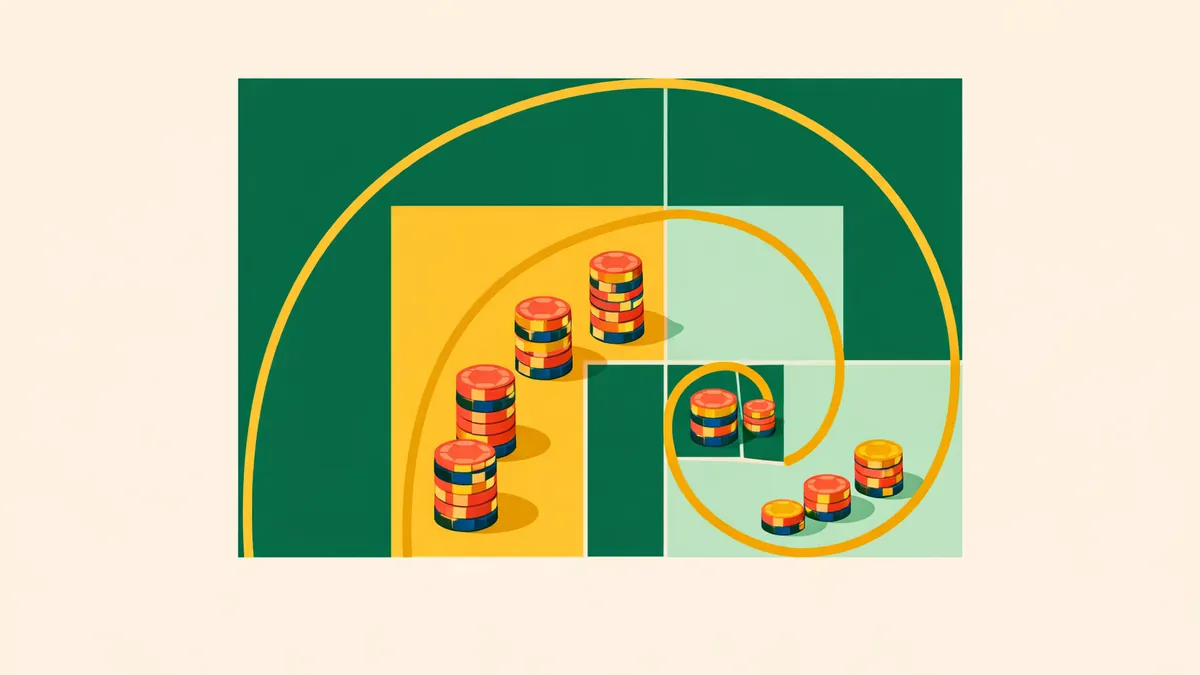
The Fibonacci betting system is a negative progression: you raise your bet after a loss, following the Fibonacci sequence, and pull it back after a win. Each number in the sequence is the sum of the two before it:
1, 1, 2, 3, 5, 8, 13, 21, 34, 55, 89, 144, 233...
The rules, for an even-money bet such as red:
- Start at the first number, 1 unit.
- After a loss, move one step to the right and bet that number.
- After a win, move two steps to the left (or back to the start if you are near it).
- The sequence is complete when you are back at the first number.
The idea is that a win at any step covers the two previous bets, so you claw back losses more slowly than the Martingale but without its brutal doubling.
A worked sequence at $5 a unit
Here is a sequence that goes loss, loss, loss, win, loss, win, win:
| Spin | Step | Bet | Result | Running total |
|---|---|---|---|---|
| 1 | 1st | $5 | Loss | -$5 |
| 2 | 2nd | $5 | Loss | -$10 |
| 3 | 3rd | $10 | Loss | -$20 |
| 4 | 4th | $15 | Win | -$5 |
| 5 | 2nd | $5 | Loss | -$10 |
| 6 | 3rd | $10 | Win | $0 |
| 7 | 1st | $5 | Win | +$5 |
Spin 6 is the important one. The win took you back to the first number, which completes the sequence, and you are exactly level. The final $5 profit came from spin 7, which is really the start of a fresh sequence that won its first bet.
The break-even trap
We worked out every possible sequence exactly on a single zero wheel, and the pattern holds every time: a Fibonacci sequence that makes it back to the first number ends either level or one unit up, never more.
| Ladder length | Bankroll needed | Biggest bet | +1 unit | Level | Bust | Bust loss |
|---|---|---|---|---|---|---|
| 8 steps | 54 units | 21 units | 48.65% | 50.17% | 1.19% | 54 units |
| 10 steps | 143 units | 55 units | 48.65% | 50.87% | 0.48% | 143 units |
| 12 steps | 376 units | 144 units | 48.65% | 51.15% | 0.20% | 376 units |
The one-unit profit happens only when the first bet of a sequence wins, which is simply the 18 in 37 chance of red. Every sequence that starts with a loss is a long walk back to zero, with a small chance of falling off the end of the ladder on the way. In plain terms: the climbing part of the Fibonacci system never makes money; it can only rescue you or ruin you.
What each step costs
The total lost after n straight losses is the sum of the first n Fibonacci numbers. At $5 a unit:
| Losses in a row | Next bet | Total lost | Chance on red (single zero) |
|---|---|---|---|
| 4 | $25 | $35 | 6.95% |
| 6 | $65 | $100 | 1.83% |
| 8 | $170 | $270 | 0.48% |
| 10 | $445 | $715 | 0.13% |
| 12 | $1,165 | $1,880 | 0.03% |
Compare that with doubling: seven straight losses cost 127 units under the Martingale strategy but 33 units here. The gentler climb is real. The catch is that a run does not have to be seven losses in a row to hurt you. Wins only step you back two places, so a choppy run with slightly more losses than wins can grind you up the ladder too.
Fibonacci over a whole session
We simulated 200,000 sessions at $5 a unit on red, stopping at the first bust:
| Ladder | Bankroll | Spins | Busted | Finished ahead | Average result |
|---|---|---|---|---|---|
| 8 steps | $270 | 100 | 35.5% | 62.8% | -$24.00 |
| 8 steps | $270 | 300 | 75.3% | 28.2% | -$49.61 |
| 10 steps | $715 | 100 | 14.9% | 80.9% | -$33.44 |
| 10 steps | $715 | 300 | 41.1% | 58.4% | -$88.36 |
The bigger ladder busts less often but loses more on average, because you bet more in total. In our exact calculation the expected result is always minus 2.70% of the amount staked; on the 8-step ladder that is minus 0.15 units per sequence on 5.68 units bet.
Fibonacci roulette on dozens and columns
A popular version of Fibonacci roulette uses a dozen or a column, which pays 2 to 1. It sounds better because each win pays double. The problem is how often you lose: a dozen misses 25 spins in 37. With one step forward for each loss and two back for each win, the average move per spin is (25 x 1 minus 12 x 2) / 37, or one step up every 37 spins. The ladder drifts upward instead of settling down.
| Measure (single zero) | Even-money bet | Dozen |
|---|---|---|
| 8 losses in a row | 0.48% | 4.34% |
| 10 losses in a row | 0.13% | 1.98% |
| 100-spin session busts, 10-step ladder | 14.9% | 88.4% |
The last row is from our simulation. On dozens the system turns into a slow, near-certain bust.
Pundit tip: if you want gentler swings than the Martingale, betting a flat $5 does that with no ladder at all, and costs exactly the same 2.70% per dollar.
Why it cannot beat the wheel
Every spin is independent; as the VGCCC puts it, what happened before does not affect what happens next. A betting sequence only decides how much you bet, so it cannot change the 1 in 37 edge on each dollar. For the reasoning behind the "a win must be coming" feeling, read our guide to the gamblers fallacy.
The other systems compared, each worked through the same way:
- D'Alembert: one unit up after a loss, one down after a win.
- Labouchere: a line of numbers you cross off as you win.
- Paroli: doubles after wins, not losses.
- Oscar's Grind: chases one unit of profit per series.
Our Martingale calculator shows how fast a doubling ladder grows by comparison. All of these were built for in-person tables; online roulette cannot legally be offered to people in Australia, as our online roulette Australia guide explains.
Our partner sites
Terms checked 8 to 9 October 2026We earn a commission if you join through these links; it pays for the site and does not change the facts we show. Listed in no particular order. Every detail comes from the casino's own terms, except ACMA notes, which come from ACMA's blocked list. These are offshore casinos without an Australian licence, so BetStop and Australian dispute services do not cover them: read whether online pokies are legal in Australia and our affiliate disclosure.Commission links. Offshore sites with no Australian licence or BetStop cover: is it legal?

LuckyOnes
Partner · termsTerms checked 9 Oct 2026- Withdrawals
- AUD 6,000 a day
- Max bet (bonus)
- AUD 8
- Min deposit
- AUD 30
- Names no licence or operating company in its terms or footer
- luckyones.com, luckyones1.com and luckyones7.com are on ACMA's blocked list (8 Oct 2026)Main domain on ACMA's blocked list

Wild Tokyo
Partner · termsTerms checked 8 Oct 2026- Withdrawals (entry)
- AUD 800 a day
- Max bet (bonus)
- AUD 8
- Monthly cap (entry)
- AUD 13,000
- States a Curacao eGaming licence (no number shown)
18+ Offers and terms change often; the casino's own terms always apply. Never gamble money you need. Free help: Gambling Help 1800 858 858, 24/7.
Frequently asked questions
How does the Fibonacci betting system work?
You bet in units following 1, 1, 2, 3, 5, 8, 13, 21 and so on, where each number is the sum of the two before it. After a loss you move one step along; after a win you move two steps back. The sequence ends when you are back at the first number.
Is the Fibonacci system safer than the Martingale?
It loses less in a bad streak but wins less too. Seven losses in a row cost 33 units under Fibonacci against 127 under the Martingale, yet both lose the same 2.70% of the total bet on a single zero wheel in our calculation.
Can you win with the Fibonacci roulette system?
You can finish a session ahead, and in our simulation about 63% of 100-spin sessions with an 8-step ladder did. Over time the busts outweigh the small wins, and the average loss is always 2.70% of what you bet.
Should you use the Fibonacci system on dozens or columns?
No. A dozen loses 25 spins in 37, so losses pile up faster than two-step retreats can undo them. In our simulation a 10-step dozens ladder busted in 88.4% of 100-spin sessions, against 14.9% on even-money bets.
How much bankroll does the Fibonacci system need?
The cost of n straight losses is the sum of the first n Fibonacci numbers: 20 units for 6 losses, 54 for 8, 143 for 10 and 376 for 12. At $5 a unit that is $100, $270, $715 and $1,880.
Related reading
 Casino games Roulette strategy Every roulette system promises to turn a losing game into a winning one. None can, and the maths shows exactly why. Here is what Martingale and the others really do to your money, and the choices that do matter. Read more
  Casino games Paroli system The Paroli doubles after wins instead of losses, so the big bets only ever risk winnings. It is the gentlest system on your bankroll, yet it still loses 2.70% per dollar. Here is how the streaks really fall. Read more
  Casino games D'Alembert system Add a unit after a loss, take one off after a win. The d'Alembert looks gentle and balanced, and an even split of wins and losses really does leave you ahead. The trouble is what happens when the split is not even. Read more
  Casino games European roulette European roulette is the single zero game, and it is the standard wheel in Australian casinos. Here is the wheel itself, the sector bets that follow its number order, and what the odds mean over a real session. Read more
  Casino games Oscar's Grind Oscar's Grind aims for one unit of profit per series and only raises the bet after a win. It is the most patient system on the table; our exact maths shows how often it works and what the rare long series cost. Read more
  Casino games Online keno Licensed online keno is legal in Australia until 31 December 2026 because the law treats it as a lottery. A new federal law bans it from 1 January 2027. Who is licensed, what is missing and what keno pays back. Read more
 Sources
Official pages we relied on. If anything here has changed, tell us via the contact page and we fix it.