
Key facts
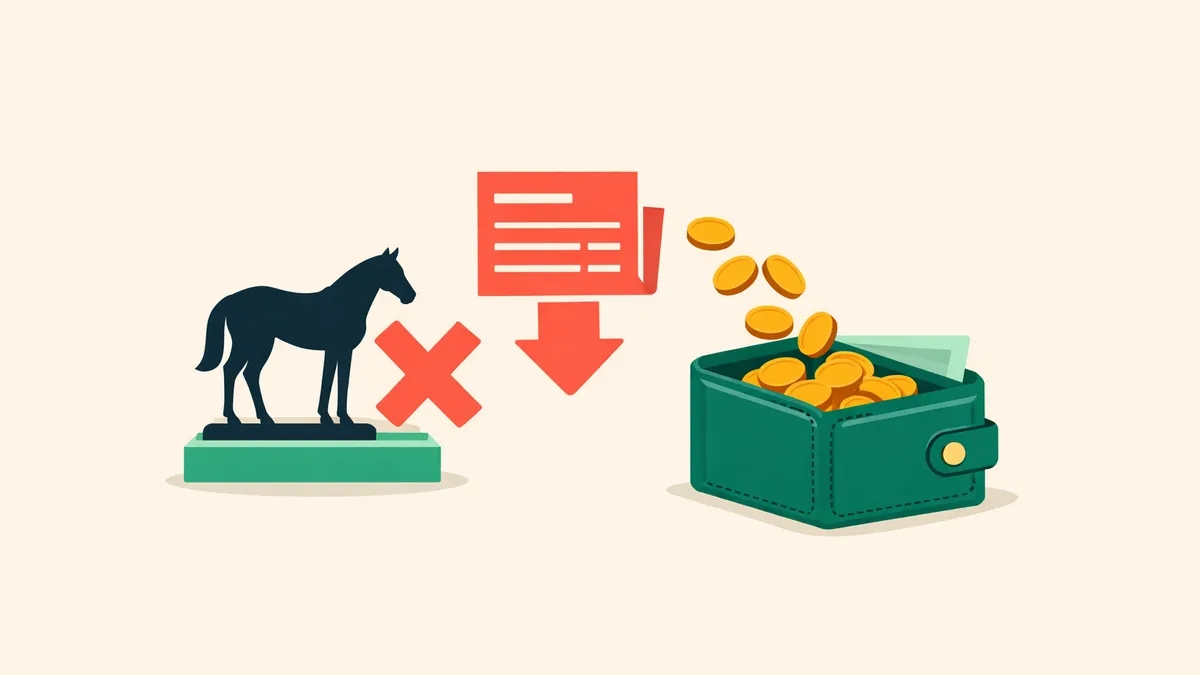
- A lay bet wins if the selection does not win. You collect the backer's stake, less commission, and risk paying out their profit.
- Liability = backer's stake x (lay odds - 1). Laying $50 at $2.40 risks $70 to win $50, or $46 after 8% commission.
- Liability climbs fast at long odds: a $20 lay at $10.00 risks $180, and at $50.00 it risks $980.
- With commission, a lay at $4.00 and 8% only breaks even if the runner wins less than 23.47% of the time, not the 25% the price implies, in our calculation.
- A staking guide on the Betfair Hub suggests laying for a liability of 5% to 6% of your betting bank, rather than for a fixed stake.
What lay betting is
Lay betting is betting that a selection will not win. You take the bookmaker's side of the deal: another punter backs the selection, and you accept their bet. If the selection loses, you keep their stake. If it wins, you pay them their profit. Betfair puts it simply: "When you place a lay bet, you are betting on something not to happen."
A lay on a horse wins if any other runner in the race wins. A lay on a footy team wins if that team loses or, in a market with a draw option, if the game is drawn.
How to lay a bet
- Open and verify an account with a licensed betting exchange. In Australia that is Betfair, licensed in the Northern Territory.
- Find the market and the selection you think will lose.
- Click the lay price. This is the price other punters are asking to back at.
- Enter the backer's stake you will accept. The bet slip shows your liability.
- Check that your balance covers the liability, then confirm.
- Wait for the match. Until another punter takes it, your offer is unmatched.
How a two-sided exchange market works, and what it charges, is covered in our betting exchange Australia guide.
The lay liability formula
Liability is the amount you could lose. Betfair's formula is:
Liability = (lay odds x backer's stake) - backer's stake
Its own example is a lay of the Sydney Swans for the AFL premiership at $8.00 with a $10 stake: the backer would collect $80, a $70 profit, and that $70 is your liability. The exchange holds your liability until the market settles.
Worked example: laying a favourite
A horse is $2.40 favourite. You think it is overrated and lay it for a $50 backer's stake, with 8% commission on Australian racing.
| Result | What happens | Your result |
|---|---|---|
| Favourite loses | You win the $50 stake, less 8% commission | +$46.00 |
| Favourite wins | You pay the backer's profit: $50 x 1.40 | -$70.00 |
Commission only applies when you win, and only to net winnings in the market. You are risking $70 to make $46, which is the mirror image of backing at $2.40.
Laying to a liability instead of a stake
Many layers decide first how much they are prepared to lose, then work back to the stake: backer's stake = liability / (lay odds - 1). That keeps the risk the same whatever the price.
A staking guide on the Betfair Hub recommends laying horses for a liability of 5% to 6% of your betting bank. Its example is a $10,000 bank laying to lose $500:
| Lay price | Backer's stake you accept | Liability |
|---|---|---|
| $2.50 | $333 | $500 |
| $5.00 | $125 | $500 |
| $10.00 | about $55 | $500 |
Our page on bankroll management covers how to size the bank itself.
Liability grows fast at long odds
Laying a fixed stake is where layers get hurt. For a $20 backer's stake:
| Lay price | Liability | Win if it loses (6% commission) |
|---|---|---|
| $1.50 | $10 | $18.80 |
| $2.00 | $20 | $18.80 |
| $3.00 | $40 | $18.80 |
| $5.00 | $80 | $18.80 |
| $10.00 | $180 | $18.80 |
| $20.00 | $380 | $18.80 |
| $50.00 | $980 | $18.80 |
At $50.00 you win $18.80 forty nine times out of fifty and lose $980 once, if the price is fair. A single longshot winner can wipe out a long run of small lay wins.
When a lay has value
Without commission, a lay at $4.00 breaks even if the runner wins exactly 25% of the time, the chance the price implies. Commission moves the bar. The break-even win chance for the selection is (1 - commission) / (lay odds - commission), and you need the real chance to be below it.
| Lay price | Commission | Implied chance | Break-even chance for a lay |
|---|---|---|---|
| $1.50 | 6% | 66.67% | 65.28% |
| $2.00 | 6% | 50.00% | 48.45% |
| $2.40 | 8% | 41.67% | 39.66% |
| $4.00 | 8% | 25.00% | 23.47% |
| $10.00 | 8% | 10.00% | 9.27% |
Say you rate a runner a 20% chance and lay it at $4.00 for $50 with 8% commission. In our calculation the expected result is 0.80 x $46 - 0.20 x $150 = +$6.80. Rate it at 25% instead and the same lay is worth -$3.00. Use the implied probability calculator to turn any price into a chance, and our guide to value betting for how to test your own estimates.
Laying to lock in a bet you already hold
The other common use of a lay is to cover a bet you placed earlier at a bigger price. If you backed a team at $6.00 and it is now $2.50 on the exchange, laying it lets you take a profit whichever way the game goes. The stakes for that are set out in our guide to hedging bets, and the lay bet calculator does the sums with commission.
Pundit tip: read the liability, not the stake, before you confirm. The stake box shows what you can win; the liability is what leaves your account if you are wrong.
What can go wrong
- No match. Betfair says unmatched bets lapse at the start of the event by default, so a lay you were relying on may never happen.
- Price moves. The lay price can shorten while you hesitate, raising your liability for the same stake.
- In-play limits. Online in-play betting on sport is prohibited in Australia, so you cannot lay a team online once the game has started. Betfair says in-play sports bets go through its phone service, with a $50 minimum. Horse racing in-play is available online.
- Commission rates differ. NRL markets carry 10% on Betfair, against 6% for other sports, which raises the break-even bar.
If laying turns into chasing your losses, the gambling help page lists free and confidential support.
Frequently asked questions
How do you lay a bet?
Open an account with a betting exchange, find the market, and click the lay price on the selection you think will lose. Enter the backer's stake you are willing to accept, check the liability shown, and confirm. The bet only stands once another punter matches it.
What is liability in lay betting?
Liability is what you lose if the selection wins. It is the backer's stake times the lay odds minus one, so a $10 lay at $8.00 has a $70 liability. The exchange holds that amount from your balance until the market settles.
Is lay betting legal in Australia?
Yes, with a licensed Australian exchange. Betfair Pty Ltd is on the Northern Territory Wagering Commission's list of licensed wagering operators. The usual limits apply, including no online in-play bets on sport.
Is laying the favourite a good strategy?
Only when you rate the favourite's chance below the break-even figure after commission. A lay at $2.40 with 8% commission needs the favourite to win less than 39.66% of the time, against the 41.67% the price implies. Laying favourites as a rule just moves the margin onto you.
What happens if my lay bet is not matched?
Nothing is bet until someone takes your price. Betfair says unmatched bets lapse and are cancelled at the start of the event by default, so an unmatched lay simply disappears at the jump or the first bounce.
Related reading
 Calculator Lay bet calculator Laying means you act as the bookmaker: you win the backer's stake if the selection loses and pay out if it wins. See your liability, your profit after commission and the chance you need to beat. Read more
  Betting Value betting A value bet is a price longer than the real chance deserves. The maths is one line; the hard part is the estimate and the patience. Here are the formulas, worked examples and the variance. Read more
  Betting Tennis betting Tennis looks like the simplest bet in sport: two players, one winner. The catch is the retirement rule, which can void a bet on a player who was winning. Here are the markets, the maths and the rules. Read more
  Betting Head to head betting Head to head is the simplest bet in sport: pick who wins. The catch is in the draw rules, the margin on short favourites and the difference between two-way and three-way markets. Read more
  Betting UFC betting A UFC fight can end by knockout, submission, a judges' decision, a draw or a no contest, and each one settles a different set of bets. Here are the markets, the scoring rules and the maths behind the prices. Read more
  Betting Cash out Cash out lets you settle a bet before the result, at a price the bookmaker chooses. Here is how that price is set, a three step check for whether it is fair, and which bets you cannot cash out. Read more
 Sources
Official pages we relied on. If anything here has changed, tell us via the contact page and we fix it.